
Of the total Rs 63,288 crore invested through the route till July, Rs 52,356 crore was invested in equities, Rs 10,429 crore in debt, Rs 250 crore in the hybrid securities and Rs 190 crore in derivatives segment.

From the Sensex pack, Reliance Industries jumped the most by 3.78 per cent. Tata Steel, Bharti Airtel, IndusInd Bank, Kotak Mahindra Bank, UltraTech Cement, ICICI Bank and Tata Motors were the other biggest gainers. Titan, HCL Technologies, Power Grid, Tata Consultancy Services, Wipro, Hindustan Unilever, Axis Bank and Nestle were among the major laggards.

After being underweight on domestic agrochemical companies and preferring global plays, brokerages believe that the former may perform better in the quarters ahead. Domestic crop protection companies have faced multiple headwinds over the past year and a half, given high inventory costs, pricing pressures, lower realisations in the generic segment, increased stocks due to lower infestations, and demand-led hits to volumes. Some of the overhang from previous quarters was reflected in the April-June quarter (first quarter, or Q1) of 2023-24 (FY24) as well, with aggregate revenues and operating profit for the sector down 12 per cent and 27 per cent, respectively.

Banking stocks dipped with Nifty PSU Bank index falling 1.7% after the government notified the ordinance that seeks to tackle non-performing loans in the sector.

Among major Sensex movers, ITC rose the most by 1.70 per cent, Wipro by 1.43 per cent, Tech Mahindra by 1.36 per cent and Nestle India by 1.27 per cent. Other gainers included HCL Tech, Asian Paints and Reliance. On the other hand, ICICI Bank, NTPC, UltraTech Cement and Tata Steel traded with a loss of up to 0.82 per cent.

L&T was the top loser in the Sensex pack, dropping 4.99 per cent, after the engineering major posted a 45 per cent decline in consolidated net profit for the September quarter. Titan, ONGC, Axis Bank, HUL, NTPC, M&M and HDFC were the other major laggards, shedding up to 3.32 per cent. NSE Nifty fell 58.80 points or 0.50 per cent to 11,670.80.

Bajaj Finance was the top loser in the Sensex pack, tanking over 10 per cent, followed by Axis Bank, Maruti, M&M, Tech Mahindra and ONGC. The gainers included ITC, Bharti Airtel, Kotak Bank and Hero MotoCorp.

'We think FY18 will end with a 10 to 12 per cent earnings growth, but FY19 will see a recovery to over 15 per cent.'

'From a risk-return perspective, large-cap funds may generate lower-than-historical average returns in 2024, whereas mid-, and small-cap funds hardly have any upside left.'

Among Sensex stocks, SBI, IndusInd Bank, HDFC Bank, Axis Bank, HDFC, Tech Mahindra, ICICI Bank, Ultratech Cement, L&T, Bajaj Finserv, Reliance, HCL Tech, Asian Paints, Wipro and M&M were the major losers. On the other hand, HUL advanced the most by 1.14 per cent. Maruti, Tata Steel, NTPC and Sun Pharma also posted gains.

It is advisable to stick to mid-caps with sustainable financial metrics rather than those offering the promise of faster growth.

'In 2022, active management, long-short strategies, multi-asset strategies, and asset allocation strategies need to be considered to meet long-term investment goals.'

Experts said the 20 per cent drop in the market poses a challenge for companies that have set the ball rolling on their IPO plans as valuations will now have to realign. This could entail more dilution or lowering of the issue size.

CLSA expects annual net inflows of $15 billion from domestic investors over the next few years in India.

The S&P BSE Sensex ended down 156 points at 25,597.

From the 30-share basket, 28 scrips suffered losses. Over 200 stocks were at their 52-week low in Tuesday's trade.

Exposure to debt funds and gold is essential even if current returns from these asset classes are low, suggests Sanjay Kumar Singh.

Benchmark stock indices Sensex and Nifty cut short their four-day gaining streak to close lower by half a per cent on Wednesday due to profit-taking in banking oil and metal stocks amid weak trends in global markets.

Indian equity markets had a good run in the first half of calendar year 2023 (CY23), with the S&P BSE Sensex and the National Stock Exchange Nifty50 hitting fresh 52-week highs. While the Sensex scaled up to a peak 64,718, the Nifty50 hit Mt 19,189. As the markets now prepare to enter the second half (H2) of CY23, all eyes are on global central banks, especially the US Federal Reserve, as to when they will pause and pivot as regards their interest-rate cycle.
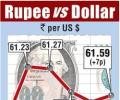
However, the hefty initial gains of the rupee, which had jumped to 61.05 intra-day, were substantially erased on month-end demand for US dollars from private oil firms and some defence-related purchases, amid fall in domestic stocks.

P-note is, however, now not a preferred route for investing in India as Sebi has made registration easier and also desirable for FPIs.
Changes in global oil and gas rates matter more to India's economy than other major economies because the country imports around 87 per cent of its oil, half of its gas in the form of LNG, and over 60 per cent of its LPG.

The rupee on Tuesday recovered from its all-time intra day low of 77.79 to close higher by 7 paise on a stellar rally in domestic stock markets. After opening lower at 77.67, the local unit plunged further to its all-time intra-day low of 77.79 due to a spike in crude oil prices and disappointing macroeconomic data. However, a strong rally in domestic equities helped the rupee rebound and close at 77.48 (provisional), showing net gains of 7 paise over the last close of 77.55. The forex market was closed on Monday on account of Buddha Purnima.

In 2015, foreign investors slowed net buying of Indian equities.

Markets ended lower following expiry of July F&O contracts and sales by foreign funds.

Since March 31, 2022, the PSBs' market cap has risen 43.7 per cent, from Rs. 7.29 trillion to Rs. 10.47 trillion. It's time for the government, the majority owner of public sector banks, to reap the benefit of the rally in bank stocks, recommends Tamal Bandyopadhyay.

Fund mobilisation by companies through equity and debt routes has dropped 20 per cent in 2022 to nearly Rs 11 lakh crore, as exuberance dwindled this year due to expensive credit avenues and volatile markets. The first half of 2023 could continue to remain challenging. The year 2021 was extraordinary for fundraising from the equity and debt routes, while 2022 has seen a slowdown in capital raising owing to elevated volatility provoked by unprecedented inflation globally and the Russia-Ukraine war.

Market participants are now awaiting Thursday's meeting of the European Central Bank
The Nifty had hit its third successive record high of 7,922.70 today.
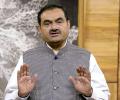
After a tumultuous past few days that almost halved value of the Adani group, embattled tycoon Gautam Adani-led conglomerate had some pressure eased on Friday as two global rating firms stuck with their calls on its credit profile and its French partner backed its investments in the group firms. Also for the first time since January 24, shares of the group's flagship firm Adani Enterprises ended in positive territory after erasing an intraday loss of 35 per cent. Adani Ports and SEZ also ended 8 per cent higher. This is after a over $100-billion rout in value of group stock since the US short seller Hindenburg Research accused Adani group of stock manipulation and accounting fraud.

All the sectoral indices, led by realty, metal, consumer durables and power were trading in the negative zone on Thursday.

Overnight, the Wall Street closed on a flatter note.

Mixed global cues and decline in crude oil prices further dent the sentiments.

Notwithstanding the robust turnaround in the financial performance for the June quarter (Q1FY24), stocks of state-run oil marketing companies have been in a downtrend in the last month. The fall comes on a rise in crude oil prices that have surged to a 7-month high of $88 a barrel. A busy political calendar in the months ahead that may see the government keep a lid on auto fuel prices is also a dampener, analysts said. Shares of Hindustan Petroleum (HPCL), Bharat Petroleum (BPCL) and Indian Oil (IOC) have shed 9-11 per cent since their respective earnings announcement between July 26 to August 4.

Equity benchmark Sensex tumbled 674 points on Friday, weighed by losses in banking stocks as an unabated spike in new coronavirus cases fuelled uncertainty over the economic impact of the pandemic. After hitting a low of 27,500.79 during the day, the 30-share BSE barometer ended 674.36 points or 2.39 per cent lower at 27,590.95. The NSE Nifty shed 170 points, or 2.06 per cent, to finish at 8,083.80.

The sharp rally in the broader markets has propelled India's market capitalisation (m-cap) to a new high. The combined m-cap of all BSE-listed firms rose to Rs 291.9 trillion in intraday trade on Thursday before settling lower at Rs 290.9 trillion. The previous record was on December 14, 2022, at Rs 291.3 trillion.

Stock markets crashed over 1,000 points or nearly 4 per cent on Monday, making it the biggest fall since 2008.
Kotak Mahindra Bank and Vedanta were the top Nifty gainers.

Among Sensex constituents, HCL Tech suffered the most by diving 2.26 per cent, followed by HDFC shedding 2.10 per cent.

The 30-share Sensex ended down 215 points at 27,011.
